Physics majors go to NASA with ‘Chip ‘n Ship’
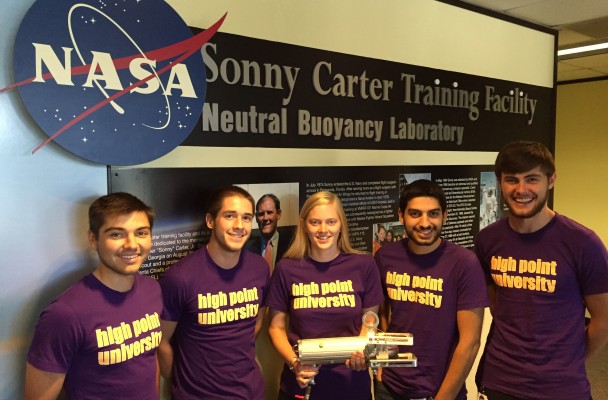
HPU Team Members at NASA’s Johnson Space Center for the Micro-g Neutral Buoyancy Experiment Design Teams Program. Photo submitted
By Madeline Travell, Organizations Editor//
NASA held a program where students from nine universities came to their center in Houston, Texas to test the devices they designed that can collect data from the surface of asteroids. The program was called Micro-g Neutral Buoyancy Experiment Design Teams (Micro-g NExT). High Point University had a team of five students from the physics club selected to attend the program with their ‘Chip ‘n Ship’ device. These students included: Hallie Stidham (senior) who was the team leader, Jake Brooks (senior), Michael Cantor (senior), Matt Iczkowski (junior) and Simeon Simeonides (senior).
The program had specifications for the models being tested and specific duties it had to preform. The criteria included that the device be “(i) be safe for astronauts to use in their spacesuits, (ii) to be operated with a single hand, (iii) chip samples from an asteroid’s surface up to 1x1x1 inch in volume, and (iv) collected three samples from three different sites, without cross contamination,” said Dr. Brad Barlow, team faculty advisor and assistant profess of astrophysics.
The project began in February when NASA accepted High Point’s proposal. High Point’s ‘Chip ‘n Ship’ device “used an air-powered pneumatic hammer to chip off samples with a chisel and collect them inside of exchangeable cartridges” explains Barlow. The team met periodically throughout the last few months of classes to brainstorm, design, and construct their device. HPU’s physics team was able to build test pieces with the 3D printer which allowed them to tweak and perfect their design. They ultimately were able to complete their prototype in July for testing in August at NASA’s Johnson Space Center in their Neutral Buoyancy Lab (NBL). The NBL is a “62 million gallon indoor pool used by astronauts to train in a micro-gravity environment” Barlow said.
The conference was broken down into four day phases at NASA. The first day consisted of a presentation to convince a panel of 10 NASA safety engineers that their device was safe for the divers to use in the NBL. The review was rigorous, the ‘Chip ‘n Ship’ device had to meet and go through all the safety procedures and specifications that NASA design engineers have to go through when trying to have their ideas approved. On the second day, the NASA divers tested the ‘Chip ‘n Ship’ in the NBL after the design had been approved. While the divers were testing the device on different mock-asteroid surfaces, the High Point student members were in a control room instructing the divers using a PA system. The third day was the day to publicize the success of their device through a three-hour long live webinar and being interviewed by local news stations. On this day also, the students were given a private tour of NASA’s Johnson Space Center. On their last day, each team presented again as a culmination of their experience of creating their device and their time there at NASA.
This was a unique opportunity for students to receive feedback from professionals in the field they are pursuing. The program hosted eight other teams from universities including, Yale University, California Polytechnic University-Pomona, Iowa State University, University at Buffalo, University of Illinois, University of Nebraska-Lincoln, University of South Florida, and University of Texas at Dallas. This student-driven program was a great way for each of the teams to see what the others were designing and how different teams took different approaches to the same prompt.